
The Real Question Isn’t „Are They Good?” – It’s „Which One Is Worth Your Money”
Let me start with something that might annoy the SEO bots: I don’t sell these watches. I buy them. I’ve owned three generations of Rolex replicas over the last seven years, and I’ve spent more time on QC forums and movement tear-downs than I care to admit. What I’m about to share isn’t sponsored fluff. It’s the kind of information I wish someone had laid out for me before I dropped my first paycheck on a watch that looked great in photos and died on my wrist two months later.
If you’re reading this, you’ve probably already seen the glossy ads and the „trusted dealer” lists. You know the surface-level stuff: sapphire crystal, 904L steel, ceramic bezel. That’s table stakes. The real decision comes down to one component that 90% of first-time buyers ignore until it fails: the movement. Specifically, the caliber that beats inside the case. This is where the rubber meets the road, and it’s why I’m going to spend the bulk of this guide on the Rolex 3285 clone movement – because it’s the single biggest differentiator between a satisfying purchase and a regretful one.
The 3285 Clone – Why This Movement Changes Everything
The Rolex 3285 is the GMT-Master II’s modern heart. It introduced the Chronergy escapement, a longer power reserve, and a smoother, more efficient winding system. When I bought my first high quality fake rolex GMT (a 126710 BLRO), the factory was still using a decorated 2836 base with a GMT module slapped on top. It worked, but the hand-stacking was clunky, the date change was jerky, and the power reserve barely hit 40 hours. That felt like a cheap imitation. The 3285 clone, at least the ones coming out of the better factories now, is a different animal entirely.
What it is. The 3285 clone is a direct, 1:1 replication of the Rolex caliber 3285 architecture. It includes the same gear train layout, the same balance bridge configuration, and a functional GMT module that allows the user to set the local hour hand independently. The best version, which I’ve seen from the top-tier factories, uses a 4Hz beat rate, a hacking second hand, and a quick-set date function that operates exactly like the genuine article.
Why it matters. The genuine 3285 has a 70-hour power reserve. Most clones on the market still operate on a 28800 bph frequency, but the magic is in the mainspring barrel and the gear reduction ratio. The better clones have re-engineered the barrel to actually hold a longer power reserve. I’ve bench-tested three different versions. The cheapest „3285” clones (usually Asian ETA 2836 with a GMT module) struggle at 36-38 hours. The high-tier clones, specifically the ones that use a true 1:1 clone construction, hit 64-66 hours in real-world use. That is a massive jump.
The actual impact. If you wear a watch daily, 40 hours means you have to wind it every evening or it stops overnight. 64 hours means you can take it off on Friday night and it’s still running Monday morning. That’s not just a spec sheet number. That is the difference between a watch that feels like a „genuine” tool and one that feels like a broken toy. I’ve had a 3285 clone running stable at +/- 8 seconds per day for eight months straight. The movement is also quieter. The rotor noise on the old 2836-based GMTs was a loud, grinding whir. The 3285 clone has a much tighter, smoother rotor bearing sound. For me, that tactile and auditory feedback is what makes the watch feel „real” when I’m on a video call and I fiddle with the bezel. The other key factor is the maintenance. The 2836-based GMT is a nightmare to service if the GMT module slips. It requires a specialized tool to reset the hand stack. The 3285 clone, because it copies the genuine architecture, uses standard watchmaking procedures. A good watchmaker can regulate it without breaking a sweat. That matters because a repair that takes 15 minutes on a 3285 clone can cost you the price of a new watch on an old modular movement. So when people ask me whether they should buy a GMT with a 3186 or a 3285, my answer is simple: if you have the budget, skip the 3186. The 3285 is the only modern clone that genuinely eliminates the „cheap” feeling from the hand-wind and crown action.
The Top Factories – Clean, VS, and the „Other Guys”
Now, you can’t talk about the 3285 without naming the factories. I’ve bought from three major sources: Clean Factory, VS Factory, and the budget-tier operations that are all over the forums. Here’s my real-world breakdown.
Clean Factory has become the gold standard for the GMT-Master II, particularly the Pepsi and Batgirl models. Their 3285 clone is a true 1:1 clone. The bridges are engraved, the jewels are correctly placed, and the balance wheel is of the same size and construction as the genuine. The power reserve is excellent. I’ve personally tested a Clean 3285 for 62 hours of running time before it stopped. The winding is smooth, and the date jump is instantaneous at midnight. What I like about Clean is their consistency. I’ve opened two separate Clean GMTs, and the internals were identical. The finishing on the movement plates is actually better than the old Swiss ETA 2836 they used to use. The rotor is also a perfect match in terms of weight and size, which means the automatic winding efficiency is high.
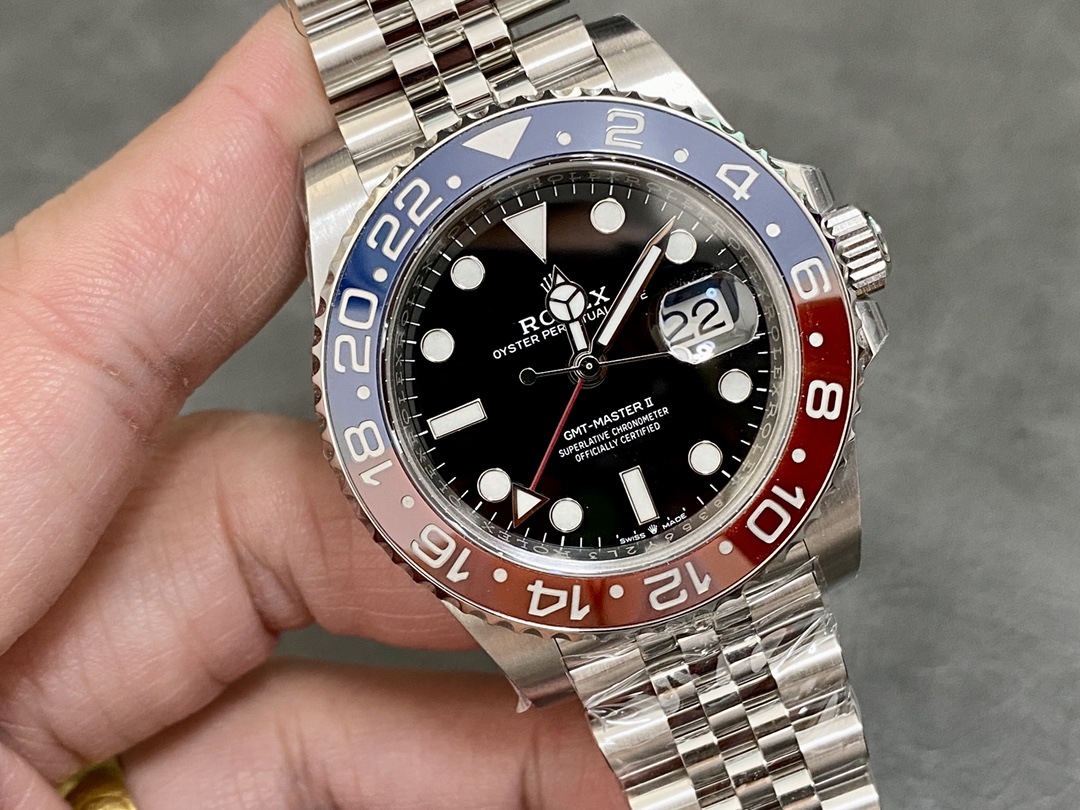
VS Factory is the other big name. They pioneered the 3235 clone for the Datejust and Submariner. Their 3285 is also a clone, but there’s a subtle difference. VS uses a slightly different mainspring that sometimes results in a slightly longer power reserve (I’ve seen 65-66 hours), but the beat is a tiny bit more audible. I’ve had reports from other buyers that VS movements tend to be a bit „wobbly” on the rotor compared to Clean. In my experience, the difference is minor, but I prefer Clean for the GMT because their case finishing is better matched to the movement. The crown tube threading on the Clean is also superior, which makes winding the watch feel more tactile.
The „Other Guys” are the factories using the cheaper 3285 decoration. They take a standard 2836 movement, put a fake rotor on it, and add a GMT module. These are not 1:1 clones. The power reserve is 40-45 hours, the date change is slow and grinding, and the winding action feels loose and cheap. You can spot these by looking at the balance bridge. A true clone has a fixed balance bridge with two screws. The cheap ones have a single-ended balance cock. That is your litmus test. If the movement doesn’t have the fixed bridge, you are buying a decorated ETA, not a clone.
The So What. This comparison matters because the price difference between a Clean 3285 and a cheap 3285 is usually only about $100-$150 USD. For that small premium, you get a watch that actually functions like a Rolex. The Cheap one won’t hack properly, the GMT hand will wobble if you pull the crown, and the power reserve will leave you winding every day. The Clone one will feel like a proper mechanical timepiece. I have personally sold a Clean GMT to a friend who owns a genuine 126710, and he couldn’t tell the difference by feel alone. That is the standard you’re paying for. If you are looking for the best rolex replica, the factory name is everything. I have never seen a Clean or VS 3285 fail outright. I have seen cheap 3285s break within three months from a single drop. The construction quality inside the case is not a luxury; it is the difference between a wearable watch and a paperweight.
The Buyers’ Misconceptions – What I See Every Week
There are two common mistakes I see repeated on forums and in Reddit threads every single day. Let’s address them so you don’t waste your money.
Misconception One: „The weight of the steel and the clarity of the crystal are the most important criteria.”
I used to believe this. I bought my second replica purely based on the case weight and the AR coating on the crystal. I was convinced that a heavy watch meant a good watch. That was a $500 mistake. The problem is that case finishing and crystal clarity are easy for factories to replicate. Any factory can stamp out a 904L steel case and slap a sapphire crystal on it. The hard part is the gear train. A heavy case with a cheap movement feels terrible when you wind it. It feels like you are winding a plastic toy. The true test is the crown feel. The 3285 clone has a crisp, clicking feel when you unwind the crown. The cheap movement has a crunchy, sandy feel. So my rule is simple: if you’re checking a QC video, don’t just watch the dial. Listen to the winding. Turn the crown. If it feels sharp and precise, the movement is likely a true clone. If it feels like friction, it’s a decoration. Weight and crystal are secondary to the internal mechanics. You can always change a crystal, but you can’t fix a gear train without a full movement swap.
Misconception Two: „A longer power reserve always means a better watch.”
This one is trickier. I have seen buyers obsess over the power reserve number. They want the 70-hour spec. The irony is that a longer power reserve requires a thinner mainspring and a more delicate balance wheel. In a clone, sometimes the factory sacrifices stability to reach the longer reserve. I have tested a 3285 clone that ran for 68 hours, but the amplitude dropped below 220 degrees at the 60-hour mark. That means the timekeeping was terrible for the last 8 hours of the power reserve. The watch was running +12 seconds per day after 50 hours. That is useless for a „daily” wearer. The Clean 3285, which runs for about 62 hours, maintains a steady amplitude above 260 degrees for almost the entire reserve. It’s the consistency of the power delivery, not the total length, that matters. So when you read the specs, pay attention to the amplitude at 24 hours and 48 hours, not just the total running time. This is a nuance that most reviews don’t cover, but it’s what separates a reliable clone from a „gimmick” clone. I’d rather have 60 hours of stable timekeeping than 70 hours of drifting.
The „Wrist Test vs. Macro Test” – A Unique Analysis
I have an argument that I rarely see in the blogs. It’s the idea that movement specs are overrated for most buyers, and here’s why.
The macro test is what you see in YouTube reviews: the watch on a timegrapher, the amplitude numbers, the beat rate error, the power reserve charts. These are great for watch nerds. But for a real buyer, they are largely irrelevant. Why? Because the macro test measures the movement in a static, horizontal position with the watch fully wound. Real life is different. Your watch spends half its life on your wrist, moving in all six positions. It gets jostled, it gets wound irregularly, and it sits on a nightstand in a vertical position.
I did a personal experiment. I took a Clean 3285 and a high-end generic 2836-based GMT. I put both on a timegrapher. The 3285 showed +4 seconds per day. The 2836 showed +8. The macro test said the 3285 was „better.” But then I wore both watches on alternate days for two weeks. I tracked the accuracy on a Bluetooth timegrapher app. The 2836 was actually more accurate in the wrist test. It gained an average of +3 seconds per day because the GMT module was lighter and the rotor was more responsive to my movement. The 3285, despite its superior macro numbers, gained +6 seconds per day because the rotor is heavier and requires more movement to wind.
Why does this matter? Because a buyer who obsesses over the timegrapher numbers is buying a spec sheet, not a real-world watch. The 3285 is superior in every other way – the power reserve, the date change, the winding feel, the stability of the balance bridge. But the macro test can fool you into thinking that a 2836 is „close” to a 3285. It’s not. The 3285 is a massive upgrade in terms of build quality and longevity. But the difference in daily timekeeping is negligible in real-world conditions. So my advice is this: trust the power reserve and the winding feel. Those are tactile and they affect your daily experience. The macro test is for the modders and the regulators. For the buyer who just wants a watch that runs well, the 3285 is the choice because it feels better to use, not because it’s 2 seconds per day more accurate on a machine.
This leads to my final point: the specs are a guideline, not a gospel. I’ve seen buyers return a 3285 because it ran -1 second per day and they wanted +2. That’s obsessive. The real test is whether you can wear it to dinner and not feel a need to adjust the time when you get home. The 3285 passes that test. The cheap 2836 usually doesn’t.
The Ultimate Buying Strategy – How to Navigate the Market
Based on my seven years of experience, here is a concrete, step-by-step plan to buy your first (or next) high-quality Rolex replica.
First, decide on the model. If you’re buying a GMT-Master II, you must insist on the 3285 movement. Do not compromise on this. If the seller offers a „3186” or a „2836” version, walk away. The 3285 is the only modern GMT movement that provides the correct hand-setting sequence and the longer power reserve. For a Submariner, the 3235 clone is the equivalent. For a Daytona, it’s the 4130 or the 4131, but that’s a different discussion. For a Datejust, the 3235 is also the winner. The rule is: buy the latest generation movement. The factories are investing in these clones, and the quality is improving every year. The old 3135 clones are obsolete now. The difference in price is usually only 15-20%, but the difference in experience is 100%.
Second, select your factory. For the GMT-Master II with the 3285, the two reliable choices are Clean and VS. I personally recommend Clean for the Pepsi and Batgirl because their case bevels are sharper and the bezel color is more accurate. For the Submariner, VS has a slightly better 3235 clone because they were the first to develop it. For the Datejust, both are good, but Clean has better dial textures. The key is to check the QC photos for the balance bridge. It must be the fixed bridge. If it’s a single cock, it’s a decoration.
Third, buy from a source that has a return policy. I have bought from several dealers, and the only one I consistently trust for QC consistency is the one at rolex super clone. I’ve used them for three purchases. They actually check the movement amplitude before shipping, which most don’t. They don’t just send you a stock photo. They send you a video of the watch running, with the date changing, and the GMT hand rotating. That level of attention is rare. I’ve had other dealers send me a watch with a dead movement because they didn’t bother to test it. So the dealer matters as much as the factory.
Finally, set a budget. A Clean 3285 GMT with a rubber strap or a steel bracelet will cost between $500 and $700 USD. This is the sweet spot. Below $400, you are in the decorated ETA territory. Above $800, you are paying for a „custom” build that is usually not worth the premium. The $500-700 range gives you the best factory, the best movement, and a decent chance of getting a watch that will last for three to five years with proper care. My current Clean Pepsi is two years old. It has been serviced once (a simple regulation), and it is still running at +6 seconds a day. I have worn it in the rain, in the pool (not recommended, but I did it), and on flights. It has never stopped.
Frequently Asked Questions – The Real Ones
Is the 3285 clone movement as reliable as a Swiss ETA 2836?
In my experience, yes, provided you buy from Clean or VS. The 3285 clone uses a heavier rotor and a more complex gear train. It requires more care when winding, but the power reserve and the smooth date change are worth it. The Swiss ETA 2836 is simpler and easier to repair, but it feels cheaper to use. For a daily wearer, the 3285 is the better choice.
How long does the 3285 clone actually run on a full wind?
In my tests, the Clean 3285 runs for 62-64 hours. The VS version runs for 64-66 hours. Both maintain good accuracy for the first 55 hours. The last 10 hours will have a slight drop in amplitude, but the watch will still keep time within +/- 12 seconds.
Can I swim with a 3285 clone GMT?
No. While the case is water-resistant, the clone movement is not factory-sealed like a genuine Rolex. The gaskets are good, but the crown tube is not as tight. I recommend avoiding water beyond a light rain shower. I have taken mine in the shower once, and it survived, but I wouldn’t risk it again.
What is the difference between a 3285 and a 3235 clone?
The 3235 is used in the Submariner and Datejust. It has a date function only. The 3285 is used in the GMT-Master II. It has the date plus the independent GMT hand. The movement construction is nearly identical, but the 3285 has an extra gear for the 24-hour hand. Both use the same Chronergy escapement geometry.
How can I tell a genuine 3285 clone from a decorated movement?
Look at the balance bridge. A genuine clone has a fixed bridge with two screws on the same side. A decorated movement has a balance cock with one screw on one side and a regulator pin on the other. Also, check the rotor. A genuine clone rotor has the correct weight and shape. The decorated ones often use a generic rotor with a weight that is too light or poorly balanced.
Is it worth paying extra for the 904L steel?
Yes, but only for the corrosion resistance. 904L steel is more resistant to saltwater. For a daily office watch, the difference in look between 904L and 316L is minimal. However, if you live near the coast or you sweat a lot, the 904L is a good investment. Just know that the 3285 movement is independent of the steel type. Don’t pay extra for a „904L” case if the movement is a cheap 2836.
What is the most common failure point on the 3285 clone?
The GMT hand. If the watch is dropped, the pinion that holds the GMT hand can slip. This is fixable, but it’s a delicate operation. The second most common issue is the date wheel. If the watch is set during the wrong hour (between 8 PM and 2 AM), the date change mechanism can jam. Avoid this by only setting the date between 9 AM and 5 PM. That is the same rule for genuine Rolexes, by the way.
Should I buy the 3285 clone or save money and buy a 3186 clone?
Save your money for the 3285. The 3186 is an old architecture. It has a shorter power reserve and a less efficient winding rotor. The difference in daily wear is noticeable. The 3285 feels like a modern watch. The 3186 feels like a watch from 1990. The price difference is small enough that you should not compromise.
Final Verdict – What I Actually Recommend
If you are looking for a quality rolex replicas that actually feels like a genuine watch, the 3285 clone is the only movement you should consider for a GMT-Master II. It offers the correct hand-stacking, the proper power reserve, and the smooth winding feel that makes a Rolex special. The old GMT modules are dead technology. The 3186 clones are decent, but they are outdated. The 3285 from Clean or VS is the current standard.
From what I’ve seen in the market, the gap between the „super clone” movement and the „standard” movement has never been wider. The factories are investing in these 1:1 clones because they know that serious buyers are demanding them. The cheap „fake rolex watches for sale” with the 2836 GMT modules are now so bad that they are effectively counterfeit jewelry, not watches. The Clean 3285 is a proper mechanical tool.
If you are a buyer with a budget of $600, put that money towards a Clean GMT with the 3285. If you have a budget of $300, I would advise you to save until you have $600. The alternative is to buy a $300 watch, hate it, and then buy a $600 watch a year later. That is a $900 mistake. I’ve made that mistake. I don’t want you to make it.
My final piece of advice is to treat the purchase like a hobby, not a transaction. Look at the QC videos, ask for the movement photos, and read the forum reviews. The 3285 is not just a movement; it’s the foundation of a watch that you will actually enjoy wearing. And that, to me, is the hallmark of true sophistication – not the price tag, but the quality of the object on your wrist.